Contest

Letter from F. E. to Mr. Gatsby

Eszter Forvith


Dear Mr. Gatsby,

I can’t say that your death didn’t shock me, although I should have expected it. From the beginning the hope you carried with your person seemed so blinding that it could easily make someone forget about what an absurd challenge you wanted to take on.

Chasing an unreachable dream. Throwing those luxurious parties in hopes that one day precious Daisy would walk in and fill that void of loneliness that eats away at the soul every day, a pain maybe you were used to having, maybe not even registering as pain. Just the quiet noises of the night, and the pink light coming from Daisy’s window, the dying hope that grew graver with each second you did not hear from your beloved those reassuring words. But who knows really, because you certainly never let anyone close enough to figure out what really lies in the heart of Jay Gatz. Maybe not even yourself. 

Even the love you had for Daisy was based on lies, you loved the idea of her, you loved her life and the way her person fit perfectly in your dream that you had so carefully built up for yourself. But maybe that’s just enough. I mean, how can you not call that pure determination and fierceness with which you fought for her anything but love? If nothing else, sheer stupidity would be a fitting alternative, but that’s as good as love, isn’t it?

Your life, filled with people that only see the surface, and in your death, nobody left to care, no one to mourn you. A happy man full of ambitious ideas and a dream for life. A man always achieving to outgrow the status he was born in, a millionaire in the mind but always that penniless poor boy at heart. 

Sincerely,

F. E.

Portrayal

Márk Kovács


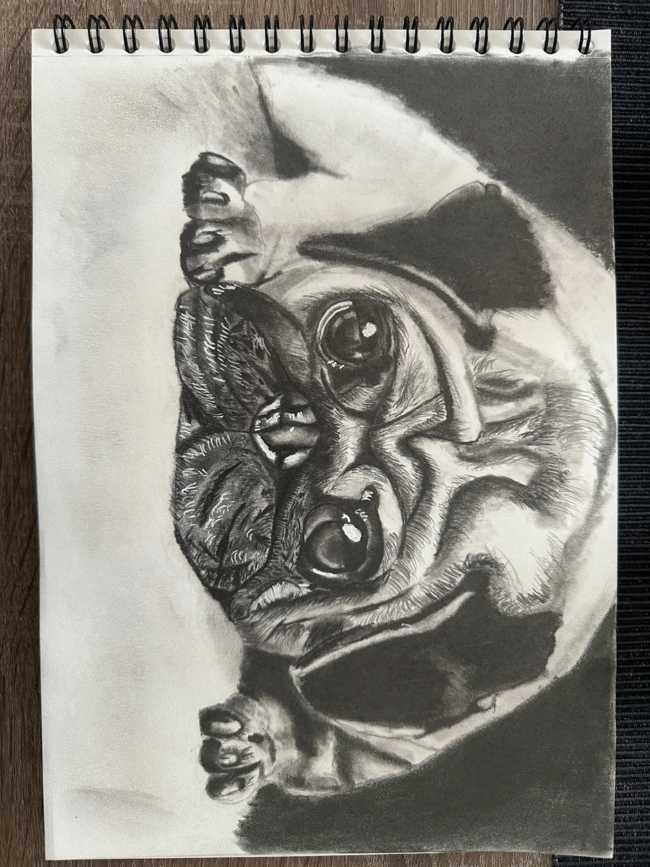
Drawing is a creative thing for me. It relaxes and switches off my thoughts. I like to just sit down, not think, just draw. I like to see how I progress step by step and the drawing starts to come together. While drawing, you realize that you are paying attention, that you are patient, focused and collected. The finished drawing, if you are satisfied, gives you a sense of success and confidence. It has been scientifically proven that drawing has a developing and stress-reducing effect. It is important that it relieves tension, the brain excludes the events of the outside world and focuses only on the given action. And last but not least, it is a very good activity. In the 12+ era, depiction and copying are gradually becoming more and more lifelike. My attached drawing (one of my favorites) depicts a pug dog. I made it based on the drawing technique that I learned from YouTube videos. These videos are very useful and provide many suggestions for lifelike depiction. It is very important to use high-quality drawing paper and pencils.

Expansion

Zsombor Górán


I always knew that physics could be a subject with infinitely many wonders in it. But the one that especially amazed me was something that most people know even before touching any physics book. It was thermal expansion that caught my eye. And what surprised me in this topic is even more specifically the fact that holes when heated expand.

They don’t expand in the way I initially thought they would. I assumed that the hole inside would get smaller whenever the material forming the hole expanded due to warmth. But much to my surprise, it didn’t. The hole will expand just as much as if it were part of the material.  This didn’t catch my eye because it was so fun to do, but because it was easy to use in the real world. It is a simple concept and it is just as simple to put in practice. If I have any problem because the manufacturer made a mistake with the sizes of metal parts, I am usually able to fix it with a simple hairdryer or in some cases boiling water. I was able to use this trick a lot even this week when building a model car. The parts were low quality and they didn’t fit; with application of heat I was able to adjust them. But this is also a bit risky; I will never be able to separate those parts again because I can’t heat one part only.  Another example of this could involve everyday items like jars. What would I do if I couldn’t open a jar? Well if you are normal, you will get someone stronger to do it. But if you want to do it alone and with a bit of style, you could just take out a few matches and drop them on the lid . The matches will burn up, warming the metal cap. And because the hole that is the rim of the metal cap expands, eventually it will be so easy to remove that even a strong wind would knock it off. This only works because the glass jar doesn’t expand as much as the aluminum and doesn’t get heated up as much either.

In all my years of school I have learned countless things that I would never use in real life; this is the only one that I actually use in everyday life. So I would call this my favorite thing I learned.

Circularity in History

Márk Gál


In my opinion, history is a wonderful subject and I think it would be meaningless and useless without circularity. When history comes to someone’s mind, it is often just through a remark that the same thing happened again in the study of a new topic, that the person heard it in a documentary, or something similar happened to him/herself and how foolish that act was. Having made this observation, the person then simply drops the subject. However, there is more to it than that, and now I will try to prove this.

The reason why repetition happens is that the doings have mostly the same consequences and we can even make similar “laws” about these schemes, as in physics. To occur, an event needs a chain of acts or activities to become real, and if you are observant enough, you can notice patterns. After you notice a pattern you should try to check out in theory what happens if you change one of its elements, what its aftermaths are, and how you might deal with them. It is not necessary for it to be a wrong pattern, as good ones can end up catastrophically when you apply them in the incorrect conditions (the people you are doing it differ, they know/do not know what you are trying to do, or the situation is distinct from the original sequence).

After you have done a few times what I wrote in the previous paragraph, it is a good idea to compare some sequences with your life, and if you find them promising, apply them to it with adjustments. Here is an example: Hitler was elected in Germany because the country’s economy was in ruins and he promised to solve it just as Caesar had done in Rome. He had ideas on how to do it, which worked, but he had extreme ones too. The German citizens were desperate and trusted in him, and after they saw the first side of the coin the other half didn’t bother them and it led to massive destruction. Now let us suppose that there are problems in your class, workplace, friend group, etc. There is a charismatic member who knows how to get rid of the problem, but has radical thoughts that can also influence your group. Firstly, don’t not let him/her do this, nor have the dangerous ideas done. Secondly, take the advice that works. Without the reforms of Hitler, Germany would still stay in the lurch for a long time. Maybe if another politician had just carried out the reforms and not killed half of a race and overrun Europe, the state and the continent’s fate would have turned out better.

All in all, I think the purpose of studying history is not to explore some tales and cram them for an exam, but rather to learn these chains of actions and consequences and apply them to your situation.

The Eruption of the Revolution

Zalán Kaposvári


Recently, in our history classes, we have been discussing the most significant changes and events that happened between the 17th and 18th centuries: namely, the time when the Enlightenment set its roots deeply within the people’s hearts.

Personally, the European event that I found particularly interesting is nothing other than the Great French Revolution.

During the whole medieval age, in all the European countries a single type of political system was dominant: absolutism. The word speaks for itself, that is, the country’s government is basically made up of one person: the king. Or more generally: the monarch (as emperors ruled in Europe as well). This person is the only one in the whole state, whose power is limitless. He is in charge of everything; he decides every single question. Of course, in more pressing, or more complicated matters, he also has his own advisors to help him resolve the given problem in a way that matches his needs and goals in the best possible way. And here comes the problem of the system. The monarch is an individual person with individual, personal thoughts, beliefs. This is precisely the fact that proves that the ruler occasionally makes a mistake, an inappropriate decision. He has his own feelings and opinions of different topics, which do not always serve the needs of his subjects.

And now, if we substitute this train of thought into 18th-century France, we get a solution. That solution, by the way, is the Great French Revolution.

The 18th century saw the continuous development of the absolutist monarchy in France, under the rule of the House of Bourbon (which had more than a dozen ”Louises”!). Even though France became the leading military power in Europe at that time, great armies require great amounts of money for maintenance. Can you guess what might have been the problem that brought this whole elaborate system to ruin? The Royal Highness and the other greatly influential aristocrats of France only made significant developments in the (completely depraved) art of making their own palaces and castles to shine and shimmer with extravagant pomp. An example of this is the Palace of Versailles, where so much luxury was created that the lords living there simply didn’t want to get their feet out of that place. They were blinded by luxury, thus they did not realize the ongoing problems and (not much later) crises that appeared in France. Another negative factor was that France did not go through capitalist transformation; instead it retained its old-fashioned feudal system. It was called, by the way, the ”Ancien Régime”, meaning ”ancient system.”

As a consequence, the state revenues were simply not enough to maintain the large, extensive, but competent army. And, as we have already stated generally, the French king, Louis XVI, was expected to find a proper solution to the greatly pressing problem. However, Louis was a very strict and truly absolutist ruler of the country, who (of course) did not want to hear about any reforms, especially those regarding capitalist transformation. Therefore, the crisis in the country deepened and deepened. What is more, the state itself suffered from total bankruptcy.

When I first heard about this complicated situation, I considered it a case that is practically impossible to solve. However, there were attempts to undo this madness in the country: the king finally convened the Estates General, or in one word: the parliament. By the way, a pretty interesting fact is connected to the latter act. Absolutism was so strong in France that the Estates General was not convened for 175 years! So the Ancien Régime was truly a strict absolutist system, indeed. Anyway, the ruler took this step in May 1789, thus the three estates had to vote in order to solve the crisis. The three groups were the Clergy, the Nobility and the Commoners. The members of the first two estates only made up 15% of the population, and the rest belonged to the Commoners. Unfortunately, the three estates were unable to decide about the future. This deepened the problems further: there were worsening working and living conditions, and beyond all of these, people suffered from famine as well.

The next step was taken by the people: protests were held in Paris. These, however, often turned into violent fights between the guards and the demonstrators (or the protesters in other words). Later, the protests spread throughout the whole country.

All these acts, all these wrong decisions only led to the outbreak of the French Revolution, which, in fact, is considered to have started on 14 July 1789. It is not by accident, believe me. The people on this famous day decided to attack the Bastille prison in order to get weapons to defend themselves against a possible attack from the king’s troops. The Bastille was also well known to the crowd as a symbol of the influence of the nobility and the rule of the monarch’s limitless power.

To sum up, I found this particular topic quite interesting because it was packed full of correlations, which, by the way, seemed too complicated at first. But if I dig deeper into the background events, it turns out to be much easier to understand, and thus, it becomes more interesting as well. After all this, I feel that, for me, revolutions are the most exciting events in history.

Under the Spell of Spiders

Áron Kaposvári


Everyone has their own experience and memories about biology, including me. What comes to my mind is about animal life, more precisely spiders.

I think everyone has met at least one spider in their life, and supposedly knows a few things about them. Considering this, I will introduce them just briefly. Spiders are fascinating creatures known for their unique ability to spin silk and construct webs. As members of the arachnid class, spiders have eight legs and two main body segments: the cephalothorax and abdomen. Unlike insects, spiders do not possess antennae or wings. Imagine you enter your room and find a dozen spiders flying around! A terrible nightmare! Spiders can be found in almost every habitat around the world. But I have good news for people with arachnophobia: there are a few spider-free places around the world like the polar regions and deep ocean trenches. So I advise you get packed-up as quickly as you can and travel to the ”edge of the world,” Antarctica. There you are certainly safe.

Most spiders are carnivorous and rely on their silk to capture their prey. Yep, you heard it right: if you bump into their cobwebs they will eat you whole. Don’t worry, I’m just joking. Focusing on hunting, web-building spiders use different designs, such as orb webs or funnel webs, while other species actively hunt using camouflage and agility. Besides that, spider silk is renowned for its strength and flexibility; believe it or not, some types are stronger than steel wires!

Spiders play a crucial role in ecosystems by controlling insect populations, making them valuable natural pest managers. Although many of you (including me) fear spiders, most species are harmless to humans. Only a small number of them possess venom capable of causing illness, and serious incidents are rare. The places with the most dangerous ones include Australia, South America, and the United States, so be aware of the dangers in these regions and countries.

Spiders also exhibit interesting reproductive behaviors. Many females create egg sacs from silk to protect their eggs. In some species, spiderlings disperse by ballooning—using strands of silk to catch the wind and travel to new locations.  Another interesting fact is that in the case of most spiders, the females are larger and stronger than the males. Considering males, at the time of mating they may perform dancing moves in front of females or hand over a ’gift’ wrapped in silk to prevent it from being eaten by others. In case the male does not win the female’s favor, (as she is mostly bigger, you can guess it) the female spider eats the male one. (Luckily, this behavior isn’t widespread among humans.)

They range widely in size, color, and behavior, with over 48,000 species documented to date. Some examples are: Black Widow, Trapdoor Spider, Twig Spider, Goliath Bird-eating Spider and Jumping Zebra Spider.

I know that most people fear these creatures, but I encourage everyone to try to like them. It may be a great challenge because I’ve heard once that there isn’t a single moment when you are more than 10 meters away from at least one spider. I can give you some advice that helped me: try looking at a spider for a prolonged period, and you’ll see that they won’t harm you. Or give them some water and watch them drink. 😊 I’ve also heard about jumping spiders that will play with laser pointers like a cat.

All in all, spiders are unique in most fields of life, from their diets to their mating. Considering their helpful habits of clearing the environment of irritating insects, we can say that they are definitely an essential part of the ecosystem.

The Art of Movement

Dafne Çavga


I started dancing when I was about five  years old. At first, I didn’t take it very seriously. I just liked the music, the rhythm, and the fun of moving around. But over time, I realized that dance is not just a hobby, it’s a way of expressing myself. Through dance, I can show how I feel without saying a single word. Every step, turn, or movement tells a story.

What I love about dance is that it’s a language everyone can understand. You don’t need to speak the same words or come from the same country to feel the emotions in a dance. I find that really beautiful. When people dance together, they connect in a special way. It’s like the music speaks for all of us. I’ve seen dancers who don’t even know each moves in perfect harmony with the other, as if sharing one heartbeat. That’s when I truly understood how powerful dance can be.

In physical education class, we learned about different styles of dance. Ballet is one of the oldest forms,it’s elegant, calm, and full of discipline. Every movement is controlled and graceful. Then there’s contemporary dance, which is more emotional and free. It allows dancers to show feelings like sadness, joy, or anger through movement. My personal favorite is hip-hop. It’s energetic, bold, and full of confidence. When I dance hip-hop, I feel strong and fearless, like I can express who I really am.

I also discovered that dance isn’t only about art,it’s also connected to science. When we move, we use physics without even realizing it. For example, when we jump, we fight against gravity for a short moment. When we spin, our bodies use balance and momentum. Even something as simple as standing on one leg uses muscles and coordination. Dance may look easy, but behind every move there’s strength, control, and a lot of practice.

Another thing I’ve learned through dance is patience. It takes time to improve and learn new steps. Sometimes I get frustrated when I can’t do a move correctly. But then, when I finally get it right, that feeling is amazing. It teaches me that progress takes effort, not perfection. Dance has also helped me become more confident. On stage, I used to be nervous and afraid of making mistakes. Now I’ve learned to just enjoy the moment and trust myself.

When I dance, everything else disappears. The world becomes quiet, and it’s just me and the music. I don’t think about school, problems, or anything else. I feel free, happy, and alive. It’s a moment where I can be completely myself. Sometimes, it even feels like time stops for a few seconds,and that’s what makes dance so magical to me.

Dance has taught me many lessons that I can use in life: confidence, teamwork, and never giving up. It helps me stay positive and express my emotions in a healthy way. I think that’s why I love it so much: it’s not only movement, it’s emotion. It’s art that lives in the body. No matter what I do in the future, I know that dance will always be part of who I am. It’s my favorite way to connect with people, to express myself, and to feel truly alive. For me, dance isn’t just something I do, it’s something I am .

Why?

Dániel Szutorisz-Pető


What’s the point of living if the world is a cruel and unjust place? Why do we trust people if we know they will betray our trust? Can you trust the ones that hurt you before? Why trust the people who hurt you? Why give them a second chance? Why give them a second shot at hurting you? Do people even have emotions when it comes to backstabbing? Do some people not have emotions at all? Why do some people not have emotions or do the things they do? Did someone do the same to them? Even if that’s true, does that justify their actions? How can an action like that be forgiven? How do some people forgive horrible things that people did to them? Why does forgiveness exist? Is true forgiveness even real?  Who was the first person to forgive? Why did they forgive? How can they let go of a wrong done to them? Do they just want to move on? But what if the other person doesn’t care? Do they know that? Do they forgive even despite that? Why move on? Why let go? Do they want to forget? Do they want to remember the good? Do they want to move forward? Can they actually move on? Does moving forward in life mean letting go of old memories? Do they keep the good memories? Why do we cherish good memories? How can we relive them? How do I get new ones? Can I get new good memories? Can I make them happen? Do I want to make it happen? Am I scared of freedom?  Is it because of the unknown? Why is the unknown scary? Is the unknown nice? Can I get to know the unknown?  Do I have to make a leap of faith?  Do I want to do that? Can I do it? Is it worth it? Will there be good memories for me ahead? Is forgiving and moving forward the way for me to get to know the unknown and see the other side? Will it make me free? When do I start? Can I do it now? Do I do it? Maybe? Why not? Is there anything holding me back? Is it that simple? Yes.

The Girl with the Violin

Ela İrem Uçarlar


It was the fourth and the last chance for me. And I failed again, like I always did. Am I upset about it? Yes, I am. But it doesn’t matter anymore. It’s not going to matter anymore when I close this page of my life. Maybe playing the violin wasn’t my thing from the beginning, even though I really like to play it. I still managed to fail the entrance exams every time. That should be a sort of warning for me.

These were the thoughts I had in my mind while I was walking without any care in the world to my train. To the train which goes far away from here. Far away from the bad memories. Far away from the expectations.

I don’t have any idea how I am going to live without the music, without my passion though. But I should figure out soon. Cause passion without success is useless; everybody knows that. Or should know that? Before it’s too late for them, like me. Before it has become the meaning of their life, their existence. That’s the part I failed like I did with my entrance exams.

But it’s not my fault. What else could I have given attention after my mother’s death? There was nothing else for me to care about that time. And right now I don’t even have that. And that’s terrifying.

While I was about to get into the train, I noticed a girl who looked around thirteen years old, with dark brown hair and green eyes. Eyes that have hope. I looked at her for a while; she was just like me with the violin in her hands. I remembered my childhood. I was just like her as well. I remembered how fascinating I found the violin’s sound when I was twelve. How I adored playing it. How my mom looked at me while I was playing it. Those proud eyes. How can I possibly forget them? And how everything was a pretty lie? That’s something I, the nineteen year old Lucy Fox, understood a couple of hours ago.

I was still watching her. She was trying to play a classic piece by Mozart. She was pretty good at it until the part where she had to use a complicated technique. The technique I spend my years on to make perfect. I wanted to tell her that she can do it if she tries hard enough. But then I realized that’s just another lie. I tried so hard as well and still can’t achieve my dreams. I wanted her to know the truth. I didn’t want her to end up like me.

When I approached her, she suddenly stopped playing the violin and looked at me. Without thinking, I started to talk with her. Maybe I could save her from the disappointment and pain. The pain of knowing that everything you’ve been trying for is just an impossible dream.

“Hello.”

“Hi.”

She smiled at me. And I hesitated for a moment. I know the things I was about to tell her would make her upset. Maybe make her lose hope about the things she loves to do but isn’t really good at it. But I guess it’s better than ending up like me.

“How long have you been playing?”

“About a year now. Do you like it?”

She asked me with curiosity. I could see that in her eyes.

“Yes, I did. But you shouldn’t have big dreams about it. Because no matter how hard you try, sometimes it just doesn’t come true. If you can’t be successful with it, maybe it’s better to find something else, something you can do better.”

After I said that, she looked at me with a blank expression. Then she stared at the ground for a while without saying a word. I knew that I had made her upset, but it was the cold and harsh truth, and I think it’s better to learn it before it’s too late. Then she suddenly looked at me and started talking.

“If I quit now, than I will lose for sure. But as long as I keep trying, I always have the chance to win.”

After she said those words, she took the violin into her hands and prepared to playing it again. While she was doing that, I was thinking about what she had said. I was the one who was staring at the ground this time. Right before she started playing again, she looked at me one more time. Then without giving me a chance to speak, she started to play. She was lost in the rhythm once again.

And this time she played the whole piece perfectly. Then she smiled at me and said:

“You shouldn’t give up because of a loss. Every winner is a loser who keeps trying until they win.”

This time I smiled at her too. Then something caught my eye. She had a necklace with her name on it.

“Lily,” I said without realizing.

“That’s me.”

I realized that I had read that name out loud when she responded.

“Thanks, Lily,” I said softly. And she smiled warmly at me one last time. Then I realized the train was about to take off. But I didn’t run. I didn’t even move an inch. I turned all the way back while taking a piece of paper out of my pocket. Then I started reading it one more time.

Keep doing things you like until the end, Lucy. Even though you lose sometimes. Perhaps one day it will become a pleasant memory you like to remember.
Your mother who loves you very much
Lily Fox

When I finished reading it, I folded it and put it back to my pocket. I started crying quietly. But who knows, even this event could become something I like to remember. Maybe even after all passes through, I can be grateful for that.

Bellow

Aslı Palaska


Everyone said Mr. Hale is the perfect teacher.

I believed it. Every laugh, every patient explanation, every small miracle of teaching made mistakes feel normal. The chalk dust clung to his fingers like smoke and his voice rolled like warm honey over the hum of the fluorescent lights. Even algebra, confusing as it is, made sense when he explained it. He moved through the room like he could bend time, kneeling beside struggling desks, whispering encouragement, adjusting papers, straightening chairs all with the same quiet authority. For a moment everything outside the classroom, the cold hallways didn’t exist. I knew in that brief golden bubble that nothing terrible could touch me while he was here.

Thursday after school, I lingered around in the library. Mom was late, so I was pretending to read. The hallway outside stretched gray and quiet. That’s when I saw him. A small black cat had slipped into the parking lot, fur all wet from the rain, eyes wide and frantic. Mr. Hale didn’t notice anyone else, he was just tracking the shadow of the cat. He bent quickly. The cat hissed, leaped backwards and then he suddenly stabbed the cat. There was a sharp snap, a thump then silence. The cat laid still, tail twitching only once before going completely limp. He straightened himself, dusted his hands, adjusted his tie and walked on with the now dead cat in his hands. I couldn’t breathe for a long time, I felt like shadows stretched unnaturally, the lot folding in on itself. I wanted to look away from the blood on the concrete ground but something tethered me to not do so at that moment.

The next day he returned to class. Chalk dust on his shirt, soft laughter, lessons rolling on like how they normally do. Yet I started to notice: the stiffness in his shoulders, the way his eyes moved so suddenly on small movements. He had a habit I had realized while following him around. On Tuesdays, he would disappear into the basement after school, carrying a box he never showed anyone. Sometimes when the janitor went by, I saw him return with the box empty. My friends didn’t notice and I didn’t dare to question it. But I could feel the pulse of it…something kept hidden, something that did not belong. Occasionally in long gray afternoons I imagine the lot again: the black cat, the sharp snap and the twitch of the tail. I imagine the box that goes into the basement each Tuesday. I do not speak of it, I only watch. Every word, smile along with every motion of Mr. Hale now feels measured. Something down there waits beneath the surface of the world I thought I knew of. Sometimes, I think it watches me back.

The hallways emptied, the afternoon light slanted through the windows: thin and yellowed. I paused at the bottom of the stairwell feeling the hum of the fluorescent lights in my chest. Somewhere below behind doors that should have led to nothing, something moved or maybe had moved. I couldn’t really tell which. I stepped back, chest tight and swallowed the thought that would not leave me: whatever was down there, whatever he kept hidden, it was waiting and it would not wait forever.

1 2 3 10